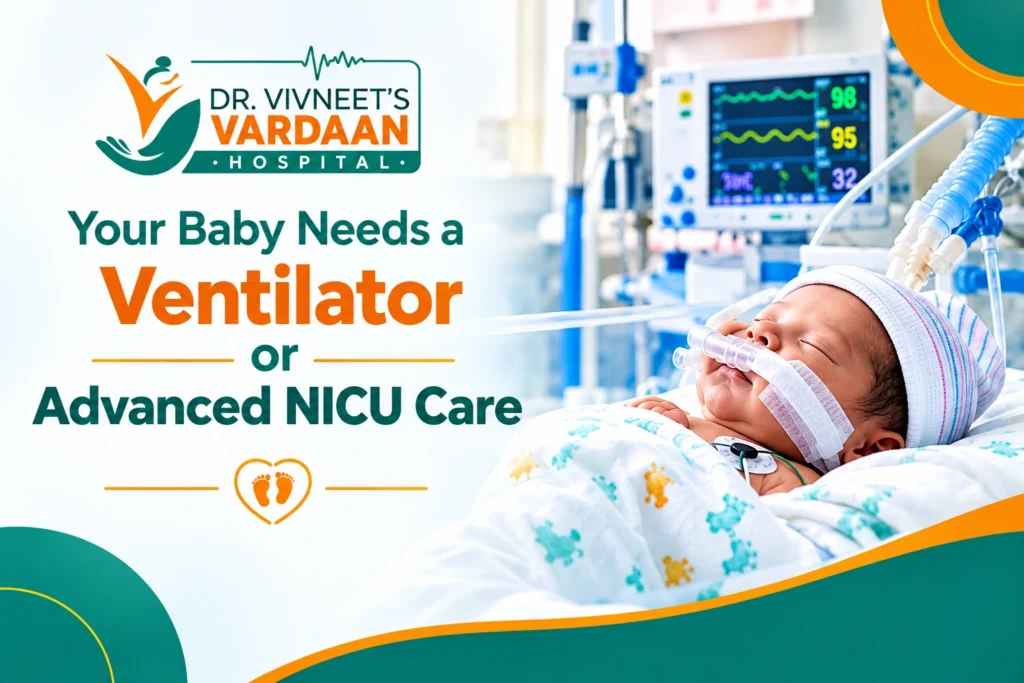
Your Baby Needs a Ventilator or Advanced NICU Care. Do You Have to Travel to Chandigarh?
When a newborn has serious breathing problems, an infection, complications from being born early, or a brain injury caused by low oxygen, quick medical care is very important.If doctors suggest taking the baby to PGIMER Chandigarh or another specialist hospital, parents may worry about the journey, finding a hospital bed, and the cost of treatment.
Another important question is whether your baby can safely get the needed treatment at a well-equipped NICU closer to home. However, going to Chandigarh may still be the right medical choice. However, if the right care and a suitable NICU bed are available in Patiala, staying closer to home may help avoid an unnecessary long journey.
Advanced newborn care available in Patiala
Dr. Vivneet’s Vardaan Hospital, near Rajindra Hospital, has a Level III NICU for newborns who need advanced care. Its listed services include:
- Conventional and high-frequency ventilation (HFOV):Breathing support for newborns with serious breathing problems, based on their medical needs.
- Inhaled nitric oxide (iNO): A specialised treatment that may be use for some newborns with high blood pressure in the lungs, after proper medical assessment.
- Therapeutic hypothermia: Carefully controlled cooling for selected babies with moderate to severe HIE caused by a lack of oxygen around birth.
- Brain and bedside monitoring: This includes aEEG/CFM, close monitoring of newborns, and other tests and intensive care support.
- Transport and continuing care: Neonatal transport support, care for premature babies, nutrition support, and treatment for serious newborn infections.
The hospital also has a PICU for seriously ill babies and children who need close monitoring and intensive care. This may include children with severe pneumonia, breathing problems, sepsis, or other serious conditions.
The hospital provides 24-hour emergency care and medical support. However, a specialist should confirm that the needed service, medical team, and suitable bed are available before accepting the child.
If your doctor recommends transfer to PGI, ask these seven questions
What is my child's diagnosis and what treatment is urgently need?
Ask why the baby needs to be transferred. It may be for a ventilator, a specific treatment, specialist surgery, or another medical service.
Has the receiving hospital accepted the patient?
When possible, the doctors at both hospitals should speak directly and confirm that the right bed and equipment are available.
Is an appropriate facility available in Patiala?
A local NICU or PICU should be choose only if it can safely provide the care your child needs.
How will the child be stabilise before departure?
Discuss the baby’s breathing, blood flow, temperature, blood sugar, medicines, and monitoring needs.
What equipment will the ambulance carry?
A very sick newborn on a ventilator may need a transport ventilator, incubator or warming support, monitors, enough oxygen, and backup equipment during the journey.
Who will care for my child during the journey?
A trained medical transport team should travel with a child who needs intensive care. They should also have a plan in case the child’s condition gets worse during the journey.
What is the payment arrangement at the destination?
Check the current scheme eligibility, hospital approval, and treatment package. In an emergency, money-related checks should not delay urgent treatment or a medically needed transfer.
These questions follow standard principles for newborn referral and transport, including communication between hospitals, stabilising the baby before transfer, and using a properly equipped transport team.
Why timing matters – especially for babies needing cooling
Therapeutic cooling is not need for every baby after a difficult birth. For selected newborns with moderate to severe HIE, doctors may start cooling as early as possible, ideally within six hours of birth. The treatment is usually carefully monitor for 72 hours. If HIE is suspect, families should speak to the treating neonatologist immediately. They should not wait for routine paperwork or try to cool the baby themselves.
Can treatment be cashless under a government health scheme?
For eligible families, the answer may be yes. However, a health card does not mean every treatment is free at every hospital. Eligibility, the treatment package, hospital approval, and any require authorisation should be check.
- Punjab families – Mukh Mantri Sehat Yojana: The state scheme may provide eligible families with cashless hospital treatment cover of up to ₹10 lakh per family each year at participating hospitals in Punjab and Chandigarh, subject to the scheme rules and approved treatment packages.
- Eligible families from other states – Ayushman Bharat PM-JAY:National portability allows eligible PM-JAY beneficiaries to use approved cashless treatment at empanelled hospitals across India, subject to verification and scheme rules. The standard national cover is ₹5 lakh per family per year. Any additional state-funded cover may have separate portability rules.
- Advanced newborn treatment packages: The National Health Authority lists therapeutic cooling under advanced newborn care and HFOV/iNO under critical newborn care. However, the exact package available in Punjab and whether the hospital can provide it cashlessly should be confirmed for each admission.
For treatments covered under an approved cashless package, eligible patients generally should not have to pay separately for those covered services. Ask the hospital’s scheme desk whether the treatment, ambulance service, or any other expense is cover under the approve package. Do not assume that showing a health card guarantees admission or that all costs will be covered.
What if you have reached Chandigarh but no suitable NICU bed is available?
A major referral hospital may be needed for some babies who require specialised treatment or services that are not available locally. When planning a transfer, ask the treating doctors to speak with the receiving hospital in advance, whenever possible. If a bed is not available, the doctors should find another suitable hospital and arrange safe care for the baby. Do not take a baby who is on a ventilator or in an unstable condition from one hospital to another in a private vehicle.
For Punjab state-scheme cardholders, check PGIMER coverage directly with the hospital’s scheme or help desk. Being eligible for the Punjab scheme does not automatically mean that every PGIMER admission will be cashless. PM-JAY beneficiaries should also confirm their national coverage and whether the receiving hospital is currently participating.
How to check a local treatment option
If a newborn or child may need to be transferred from Rajindra Hospital, Mata Kaushalya Hospital, or another hospital, the parent or treating doctor can contact Dr. Vivneet’s Vardaan Hospital. The receiving team should review the child’s medical details, check if the required treatment and bed are available, confirm scheme coverage, and advise if a safe medical transfer is suitable. If another hospital can provide care that Vardaan cannot, the child should be transfer to that appropriate centre instead.
Follow up Instagram and Facebook for more information.
Frequently asked questions
My baby does not have a separate health card. Can we still apply?
Ask the scheme desk if your newborn can be add to an eligible parent’s family record and which documents are need. If the baby does not have a separate card yet, do not delay getting urgent medical care.
Can iNO, HFOV and cooling be provide free of charge?
These treatments are list in national newborn-care package descriptions. However, cashless treatment at a specific hospital depends on your family’s eligibility, the baby’s medical needs, the hospital’s approved packages, and admission approval. Contact the scheme desk for confirmation about your case.
Are older children treat too?
Yes. The hospital provides PICU care for seriously ill children beyond the newborn stage. Ask the receiving team to confirm the level of care need and whether a suitable bed is available.
Does every baby referred to PGI need to stay in Patiala instead?
No. Some babies may need care at PGIMER or another specialist hospital. The right hospital is the one that can provide the care the child needs in time. The treating and receiving doctors should make this decision with the family.
Can we drive our ventilated baby ourselves?
Do not move the baby without approval from the treating doctor. A very sick baby may need continuous breathing support, close monitoring, temperature control, and a trained medical transport team.